THE SFA has put out a full and robust statement dealing with the incredible aftermath of Celtic’s win against The Rangers.
For nearly a week, a meltdown online from their supporters egged on by the club looking to blame officials and asking for audio has seen a lot of vitriol thrown the way of SFA staff.
After a meeting between Rangers and the SFA, the Ibrox club put out a statement that the SFA has said is not reflective of how the meeting went and the SFA believe the club stoked the flames of the situation by misrepresenting the meeting.
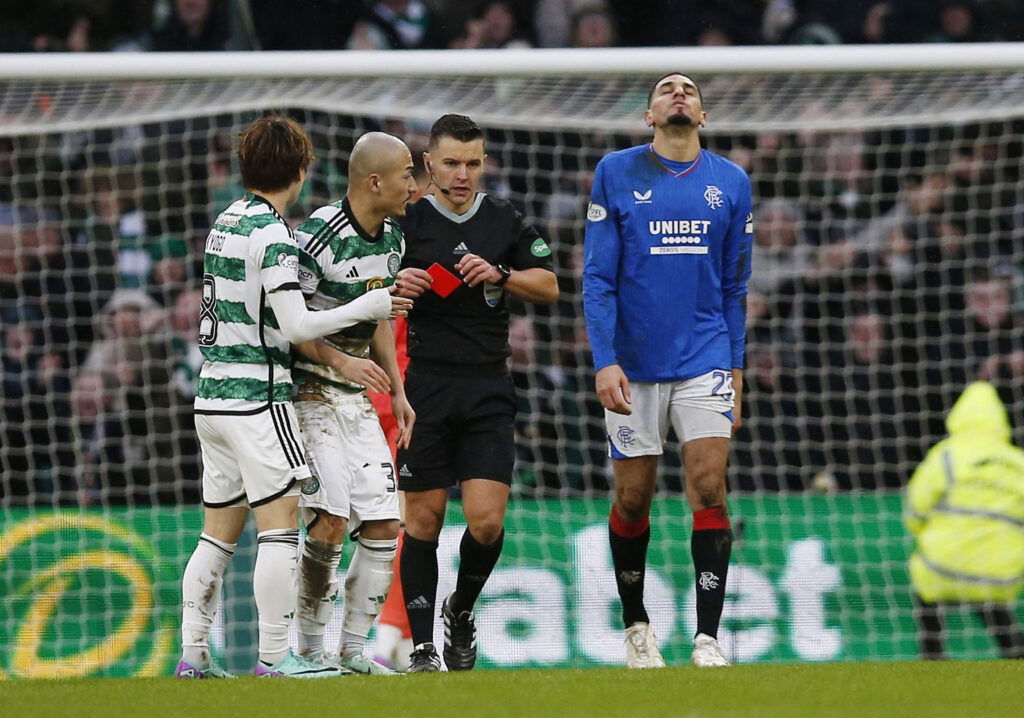
This all centres around a penalty that wasn’t given to The Rangers. Alistair Johnston’s hand hit the ball on the way out of the field and VAR official Willie Collum believed it was not a hand ball. The aftermath of the decision saw an uproar as the game was going on, a clip then appeared to show that even had Collum thought it was a hand ball, the decision to give a penalty would not have stood because Sima was in an offside position in the attacking phase of play.
Despite there being no wiggle room for this ever to be a penalty, the meltdown has been incredible and it looks like a campaign to try and exert pressure on officials going forward.
Rangers lost because Celtic were better than them on the day. For some it’s just too hard to handle.
Full statement:
Certainly, here is the text formatted into readable paragraphs:
The Scottish FA is disappointed by contents of the most recent statement issued by Rangers in relation to a match incident during the club’s recent Premiership fixture against Celtic.
Chief Executive James Bisgrove and Director of Football Operations Creag Robertson attended a private briefing with the Head of Referee Operations, Crawford Allan, to review the incident in question, including the use of matchday audio. We understood from the chief executive that the meeting had been constructive and informative, and conducted amicably.

This does not appear to be reflected in the club’s statement.
During the meeting, it was pointed out that the incident in question was a subjective handball and that the VAR did not deem it a sufficiently clear and obvious error to refer to On Field Review.
Furthermore, the offside would not have been mentioned at the time as it was not part of the VAR’s decision-making on the handball. It was highlighted within Clydesdale House that had the VAR considered the incident to be a handball offence and asked the referee to carry out an On Field Review, the Attacking Phase of Play would have been checked and an offside would have been identified. This supplementary information was relayed to broadcasters in-game, and we are reviewing the process of information dissemination to avoid any perceived ambiguity in future.
There was an overall consensus that the incident could not have led to a penalty kick being awarded in any event, and that there was no impact on the final outcome of the match.
Scotland’s VAR protocol is in many ways modelled on the PGMOL system, and we are in regular dialogue with our colleagues in England on knowledge sharing and improvements. VAR has been operational in Scotland for just over a year, whilst it has been operational in England for more than four.
Since the summer, we have ensured that Key Match Incidents are reviewed and shared with all clubs after every full round of 11 Premiership fixtures, including use of audio. We will continue to do this, along with KMI being shared with the Independent Review Panel for their consideration and opinion.
Finally, we note posts from a recent official media partner of the club’s detailing requests from the private meeting that were immediately rejected. We would ask that club representatives show greater responsibility in such matters, especially in the context of recent incidents in European football that have compromised the safety of match officials and led to widespread condemnation.